Emotional awareness means knowing the difference between feeling an emotion and getting caught in the story around it. It helps you notice and manage your feelings while staying calm and focused. When you understand this difference, it becomes easier to be aware of what you’re feeling without becoming overwhelmed.
Disconnecting from our inner selves can lead to a build‑up of unprocessed emotions, resulting in anxiety, burnout, and unhealthy relationships. The good news is that emotional awareness is a skill that can be developed without extensive meditation or training.
To boost our emotional intelligence, we can add simple habits to our everyday routine. When we learn to notice our feelings without getting lost in the stories that go with them, we can more clearly see the difference between feeling an emotion and being overwhelmed by it. This ability helps you recognise and manage your emotions, promoting a sense of calm and balance.
Understanding What It Means to Witness Your Emotions:
Before we dive into the practices, it’s important to understand the difference between witnessing and absorbing our emotions. When we absorb an emotion, we completely identify with it. We become angry, sad, or fearful. This often leads to a victim mentality: “Why did this happen to me?” “They always treat me this way.” “I’ll never get past this.”
These thoughts intensify emotional turmoil and can trap us in repetitive cycles. However, when we observe an emotion, we take a step back and acknowledge that we are experiencing it, rather than being overwhelmed by it.
This creates a space for reflection, allowing a person to notice what’s happening without being consumed by it. Imagine yourself as the sky and your emotions as weather patterns moving through it. The sky doesn’t disappear when clouds come; it remains big enough to hold everything.
This practice does not mean that you push away or judge your feelings. Rather, it means you respect them completely while maintaining a grounded connection with your own awareness.
1 – The Body Scan Check In:
Our body functions as a reliable emotional indicator; however, many of us neglect to pay attention to its signals until they become too intense to overlook. The body scan technique involves focusing on different parts of the body and paying attention to our feelings without trying to change them.
The Process:
First, find a comfortable sitting position and take three slow breaths. Begin at the top of your head and slowly direct your attention down through your body. Include your forehead, eyes, jaw, neck, shoulders, arms, hands, chest, abdomen, hips, legs, and feet. As you move through each area, simply observe how it feels. You may notice tension in your jaw, heaviness in your chest, or a knot in your stomach.
The Understanding:
These physical sensations often carry emotional messages that your conscious mind may have overlooked. The important thing is to observe them without labelling them as good or bad. A tight muscle is not a sign of failure; it is feedback. By regularly checking in with your body in this manner, you become familiar with your normal state, which makes it easier to detect any changes.
With practice, you may even notice an emotion starting to surface before it fully grabs your attention. This gives you valuable time to react thoughtfully instead of impulsively.
Created from the ISU download
2 – Naming What We Feel:
Expressing our feelings can be powerful. When we label an emotion, we activate the prefrontal cortex, which helps regulate the amygdala. The amygdala triggers emotional responses. Therapists often encourage clients to talk about their feelings because expressing them can calm the nervous system. However, many people struggle to describe their emotions and often resort to generic terms like “bad” instead of identifying specific feelings such as disappointment, shame, frustration, or grief.
Become the Emotional Awareness Detective:
To improve our emotional awareness, consider keeping a notepad handy or using a notes app on your phone. Throughout the day, pause and ask yourself, “How am I feeling?” Then try to be specific. Instead of saying “stressed,” you might feel overwhelmed, undervalued, or uncertain. Instead of “upset,” you might be hurt, betrayed, or disrespected.
It’s in the Details:
Being specific matters because different emotions require different responses. Anger might suggest that a boundary has been crossed, while sadness could mean that we need to mourn a loss.
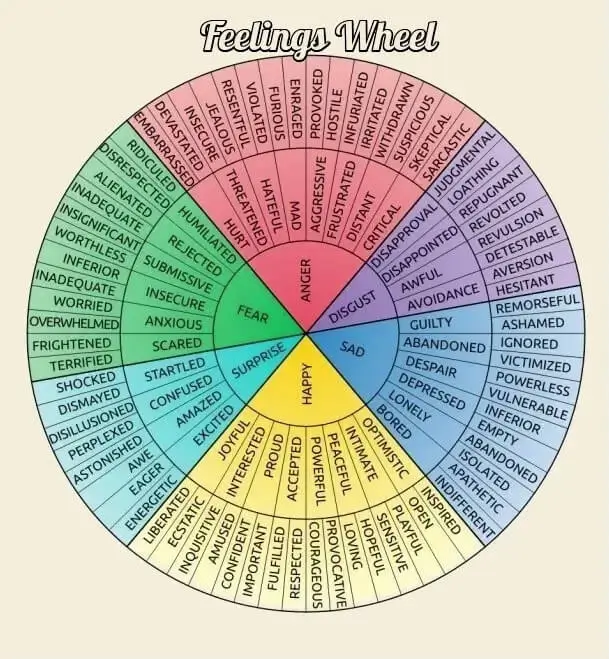
Developing an emotional vocabulary helps a person understand themselves more clearly. Many people find a feelings wheel useful. This resource starts with basic emotions like sad, mad, and scared, and branches out to more detailed variations. The goal isn’t perfection; it’s about practising expressing your inner feelings with greater ease.
To get the Hoffman’s feeling list PDF, click here and for the ISU Feelings Wheel, click here.
3 – The Sacred Pause:
When faced with tough emotions or situations, we often react impulsively. We might send a harsh text, make a hasty decision, or continue to overthink it. The sacred pause is about taking a moment to stop between what happens and how we respond.
This creates a space where our higher self can catch up with our automatic reactions. Taking three deep breaths can create enough space to change how we experience things. When we feel a strong emotion coming on, it helps to recognise, “I see that I’m feeling angry right now.” This simple acknowledgment doesn’t change the fact that we’re angry, but it does shift our relationship to the anger.
The Emotional Awareness Recognition Shift:
The recognition shift occurs when we are able to detach ourselves from intense emotions. It is when we transition from being angry to observing our anger. Imagine viewing the scene as if you were a third person. It’s as if you’re watching yourself on a TV show.
This doesn’t mean we’re disconnecting from our feelings. It means we’re connecting with the part of ourselves that remains calm, even when emotions are running high. With practice, it becomes easier to use the sacred pause, and we may find that we can handle difficult situations with much more grace than we ever thought possible.
4 – Observing Without Story Making:
This practice builds on the previous three and represents the most advanced skill in emotional awareness. When an emotion arises, observe how your mind immediately starts to create a story around it. This story may blame someone else, rehash past grievances, or conjure up negative future scenarios. These narratives are natural; however, they are not necessary.
Using Emotional Awareness to Quieten the Mind:
Watching without creating a story means letting the feeling be in its simplest form, without any extra layers of meaning. To practise this, set aside five to ten minutes in a quiet place and allow your mind to settle. When an emotion arises, resist the urge to figure out where it came from or what it means.
Just pay attention to it. Feel how it feels, its heaviness, and how warm or cool it is. Notice where it is in your body. Watch it rise, reach its peak, and begin to fade without pushing it away or pulling it closer. You could say to yourself, “There is anger” or “There is sadness,” viewing these feelings as passing visitors rather than permanent residents.
Emotional Growth:
At first, this way of learning may seem strange or even a little uncomfortable. Our minds crave stories and explanations. However, learning emotional awareness is a skill that keeps us grounded during chaotic times. This type of learning happens through real experiences rather than just thinking about it.
As time goes on, you might notice that when you let go of stories, your feelings can flow through you faster and more fully. They turn into waves that rise and then fade away, instead of strong currents that drag you down.
5 – The Evening Review:
This last practice is about taking some time at the end of each day to think about how you felt. It doesn’t have to take a long time; usually ten to fifteen minutes is enough. Just find a calm place and think back on the day that has just gone by. What emotions surfaced? Without judging them, trace these emotions through your day.
Maybe you felt nervous in the morning, annoyed while travelling, and calm in the evening. Look for any patterns. Did specific people, places, or activities always make you feel a certain way? As you think about the day, try not to change it or make plans for tomorrow. Simply observe what happened.
Having An Emotional Awareness Mindset:
You can write down a few sentences in your journal, or simply reflect in your mind. This review process has a few important purposes. It helps you notice emotional patterns that you might not see otherwise. It shows you that feelings are temporary; they come up, stay for a while, and then fade. It also gives you a chance to find closure, helping you release any unresolved feelings before you go to sleep.
As you keep doing this over the weeks and months, you’ll gain a better understanding of your inner self and a greater appreciation for how your emotions change.
Bringing the Steps of Emotional Awareness Together:
Reaching a constant state of calm or completely getting rid of difficult emotions is not the goal of learning emotional awareness. Life will always have its share of loss, frustration, fear, and sadness. Instead, it’s about building a better relationship with your inner self. This means being curious instead of judgmental, being present instead of running away, and observing instead of getting lost in your feelings.
The five practices of body scanning, naming emotions, the sacred pause, observing without story making, and the evening review are not meant to be tackled all at once. Choose one or two that resonate with you and start there. You might begin your mornings with a quick body scan or keep an emotional awareness journal next to your bed. Once these habits feel natural, broaden your range of activities.
Emotional Awareness Closing:
Being aware of our emotions is important for understanding and managing how we feel, which supports our mental health. When we know our emotions and why we feel that way, we can handle situations more thoughtfully and positively. This awareness helps us notice things that might trigger difficult feelings, so we can find ways to cope that make us stronger.
Emotional awareness also helps us feel empathy, allowing us to connect with others more effectively and understand their feelings. In short, developing emotional awareness is important for living a balanced and steady life, as it gives us the confidence and clarity to work with our emotions rather than be overwhelmed by them.
About the Author
Hello, my name is Sherri. I have training in various holistic and non-holistic healing methods, including NLP, EFT, hypnotherapy, shamanic practices, and Reiki, among others. My knowledge extends to Ayurvedic medicine, astrology, and more. Although I no longer offer hands on healing, the insights I’ve gained continue to influence my writing and reflections.